
Amazon interview questions: boost your clarity and camera confidence

TL;DR:
- Amazon values strong communication, camera presence, and authenticity alongside technical expertise.
- Structuring answers with frameworks like CAR and quantifying impact are crucial for success.
- Practicing on camera, focusing on clarity and confidence, significantly improves interview performance.
Facing Amazon’s interview process is genuinely daunting, even for experienced professionals. When recruiters assess not just what you say but how you say it, the pressure intensifies significantly. Camera presence and authenticity are now as critical as technical depth, and that means your delivery can make or break an otherwise strong answer. In this article, you’ll find everything you need: the exact criteria Amazon uses, the top questions for mid-to-senior roles, a clear comparison of answer frameworks, and practical strategies to sharpen your clarity and confidence on camera. The advice here draws on current recruiter insights and proven preparation approaches.
Table of Contents
- How Amazon evaluates candidates: key criteria explained
- Top 10 interview questions from Amazon (with on-camera answer tips)
- Comparing answer frameworks: STAR vs. CAR vs. SOAR for Amazon
- Mastering communication, clarity and presence on camera
- What most Amazon interview guides miss: the clarity-confidence edge
- Accelerate your Amazon interview success with expert tools
- Frequently asked questions
Key Takeaways
| Point | Details |
|---|---|
| Understand Amazon’s criteria | Amazon values clear, authentic communication and impact-focused answers—especially in camera interviews. |
| Prepare for common questions | Practise top behavioural and technical questions using proven answer frameworks like STAR and CAR. |
| Choose the right answer structure | STAR, CAR, and SOAR frameworks each have strengths—pick the best match for question and style. |
| Practise on-camera presence | Confidence, clarity, and authenticity during video responses are as vital as technical skills for success. |
| Leverage practice tools | Enhance your readiness with expert-led mock interviews and clarity analysis resources. |
How Amazon evaluates candidates: key criteria explained
Now that you know what’s at stake, let’s look at what Amazon truly values in its candidates. Understanding this is your starting point for any serious preparation.
Amazon’s 16 Leadership Principles are not just a corporate slogan. They are the literal scoring rubric interviewers use. Every question you face, whether behavioural or situational, maps directly back to one or more of these principles. For mid-to-senior roles, the bar is significantly higher. Vague answers won’t cut it. You need to demonstrate clear, measurable impact and show nuanced judgement in ambiguous situations.
What surprises many candidates is how heavily communication quality factors into assessment. Amazon’s process values clear communication and presence, particularly in virtual and video interview rounds. This means your camera skills, tone of voice, eye contact, and overall authenticity are actively being assessed alongside the substance of your answers.
Here’s what Amazon evaluates across all stages:
- Behavioural depth: Can you articulate specific decisions, trade-offs, and outcomes from your past experience?
- Impact quantification: Do you use data and metrics to illustrate results rather than vague descriptors?
- Communication clarity: Is your answer structured, concise, and easy to follow without rambling?
- Camera presence: Do you come across as confident, composed, and authentic rather than scripted or anxious?
- Principle alignment: Does your example genuinely reflect an Amazon Leadership Principle in action?
For camera interview techniques specifically, presence scores you real differentiation points in remote rounds. A technically strong answer delivered with poor pacing and avoided eye contact will still leave interviewers less convinced than a slightly simpler answer delivered with confidence and clarity.
“The best candidates are the ones who feel like genuine people, not rehearsed performers. Practice is essential, but the goal is natural confidence, not a polished script.” — AWS Recruiters
Pro Tip: Swap memorising scripts for practising your key examples aloud on camera. Watch your recordings back critically. Notice where you rush, where you lose structure, and where you sound most natural. That self-awareness is what builds real presence over time. You can also explore the demands of technical and behavioural rounds to understand what genuine depth looks like at the senior level.
Top 10 interview questions from Amazon (with on-camera answer tips)
Having covered Amazon’s expectations, here are the real questions you’ll face, with actionable advice for each.
Amazon relies heavily on behavioural questions structured around its Leadership Principles. For senior roles, you’ll also encounter situational and analytical questions that probe your strategic thinking. The STAR framework (Situation, Task, Action, Result) and CAR framework (Context, Action, Result) are both effective, but only when used with genuine specificity. Practising proven Amazon questions before your interview is essential to internalise this rhythm.
Here are the 10 most frequently asked Amazon interview questions for mid-to-senior roles:
- Tell me about a time you disagreed with a decision and how you handled it. (Targets: Have Backbone; Disagree and Commit)
- Describe a situation where you had to deliver results under significant constraints. (Targets: Deliver Results, Frugality)
- Give an example of when you used data to make a difficult decision. (Targets: Are Right, A Lot; Dive Deep)
- Tell me about a time you took ownership of a problem outside your remit. (Targets: Ownership)
- Describe a project where you had to influence without direct authority. (Targets: Earn Trust, Vocally Self-Critical)
- How have you handled a situation where a customer’s needs conflicted with business goals? (Targets: Customer Obsession)
- Tell me about a time you had to simplify a complex problem. (Targets: Invent and Simplify)
- Describe your approach to developing team members. (Targets: Hire and Develop the Best)
- Give an example of a calculated risk you took and the outcome. (Targets: Bias for Action)
- Tell me about a time you raised the bar for quality. (Targets: Insist on the Highest Standards)
For each question, your on-camera delivery matters as much as the content itself. Practising answers aloud builds confidence and reveals clarity gaps, and quantifying your impact is consistently preferred over vague narrations. Aim for answers between 90 and 120 seconds. Anything longer and you risk losing the interviewer’s attention on screen.
Pro Tip: Record yourself answering each question using mock interview practice sessions. On playback, check whether you open with the context clearly, land on a specific result, and maintain a steady pace throughout. Doing this even three times per question will transform your delivery.
Comparing answer frameworks: STAR vs. CAR vs. SOAR for Amazon
You’ve got the common questions, but how you structure answers is just as vital. Here’s how the main frameworks compare.
Three frameworks dominate interview preparation at senior level: STAR, CAR, and SOAR. Each has its strengths, and the best candidates adapt rather than rigidly follow one method.
| Framework | Clarity | Conciseness | Impact emphasis | On-camera suitability |
|---|---|---|---|---|
| STAR | High | Moderate | Moderate | Strong for behavioural |
| CAR | Very high | High | High | Excellent for senior roles |
| SOAR | Moderate | Lower | Very high | Good for strategic examples |
SOAR stands for Situation, Obstacle, Action, Result. It adds an extra layer that highlights problem-solving under pressure, which is valuable when you want to demonstrate resilience and adaptability.
Here’s when to use each framework:
- STAR: Use for standard behavioural questions where a clear beginning, middle, and end structure works naturally.
- CAR: Use when you want maximum efficiency. This framework strips away unnecessary context and focuses on what you did and what resulted.
- SOAR: Use when the obstacle itself is the most compelling part of the story, for instance, when you navigated a crisis or turned around a failing project.
Amazon recruiters recommend structuring responses concisely and clearly, and quantifying outcomes whenever possible. Specificity and brevity together create the strongest impression.
For mock interviews for frameworks, the most useful exercise is to practise the same story using all three frameworks and compare how each one lands on camera. You’ll quickly discover which feels most natural and which communicates the impact most powerfully.
Mastering communication, clarity and presence on camera
Knowing frameworks isn’t enough. Delivery is everything. Here’s how to bring your answers to life on camera.

Many candidates arrive in virtual interviews with strong content but struggle to project the clarity and composure that senior roles demand. The good news is that these skills are trainable. Presence and authenticity sway outcomes more than pure memorisation, and targeted practice accelerates improvement faster than most people expect.
| Common challenge | Practical solution |
|---|---|
| Speaking too fast under pressure | Practise pausing deliberately after each key point |
| Losing structure mid-answer | Use a mental signpost: “The situation was… I did… The result was…” |
| Avoiding eye contact on screen | Look at the camera lens, not your own image on screen |
| Overusing filler words | Record yourself and count fillers; awareness reduces them quickly |
| Sounding scripted or flat | Prepare three key points per answer, not word-for-word scripts |
Here are five rapid clarity-boost exercises to do before your interview:
- Two-minute timer drill: Answer a random question in exactly two minutes. Stop when the timer ends, regardless of whether you’ve finished. This trains conciseness.
- No-filler challenge: Record a single answer and commit to zero filler words. Replay and score yourself honestly.
- Camera eye-contact practice: Spend five minutes talking directly to your camera lens about anything. This trains your eyes to stop wandering.
- Quantification prompt: For every answer you practise, ask yourself, “What was the measurable outcome?” If you can’t answer that, your story isn’t ready.
- Playback review: Watch recordings without sound first. Notice your facial expressions, posture, and energy. Then watch with sound. Both dimensions matter equally.
For further online practice for confidence, building a consistent pre-interview routine will help you arrive feeling prepared rather than anxious.
Pro Tip: Authenticity always beats over-rehearsal. Interviewers respond to candidates who feel present and engaged, not ones who sound like they’re reciting a script from memory. Prepare your key points thoroughly, then trust yourself to deliver naturally.
What most Amazon interview guides miss: the clarity-confidence edge
Here’s something worth sitting with. Most Amazon interview guides focus almost entirely on what to say. They give you question lists, framework acronyms, and example answers. What they rarely address is the honest discomfort of performing well on camera when the stakes feel this high.
At the mid-to-senior level, every candidate interviewing alongside you has strong experience. They’ve led teams, managed budgets, and navigated complex decisions. The differentiator, far more often than most guides admit, is how clearly and confidently they communicate on screen. A quantified, well-structured answer delivered with genuine composure signals seniority in a way that no amount of rote preparation can fake.
The candidates who succeed don’t eliminate nerves. They learn to speak with clarity despite them. That’s a practised skill, not a personality trait. Exploring master interview presence through deliberate camera practice is where real progress happens. Embrace the imperfection in your early recordings. Each one teaches you something. Clarity and genuine connection are the real edges that win Amazon interviews.
Accelerate your Amazon interview success with expert tools
Ready to turn advice into action? Here’s how Pavone can help you master every aspect of the Amazon interview.
Pavone.ai gives you a private, pressure-free space to record real interview-style answers and receive immediate, specific feedback on your clarity, pacing, structure, and confidence. Whether you’re working through the interview question generator to build your question bank or refining your delivery through targeted master online practice sessions, every tool is designed around how you actually come across on camera.
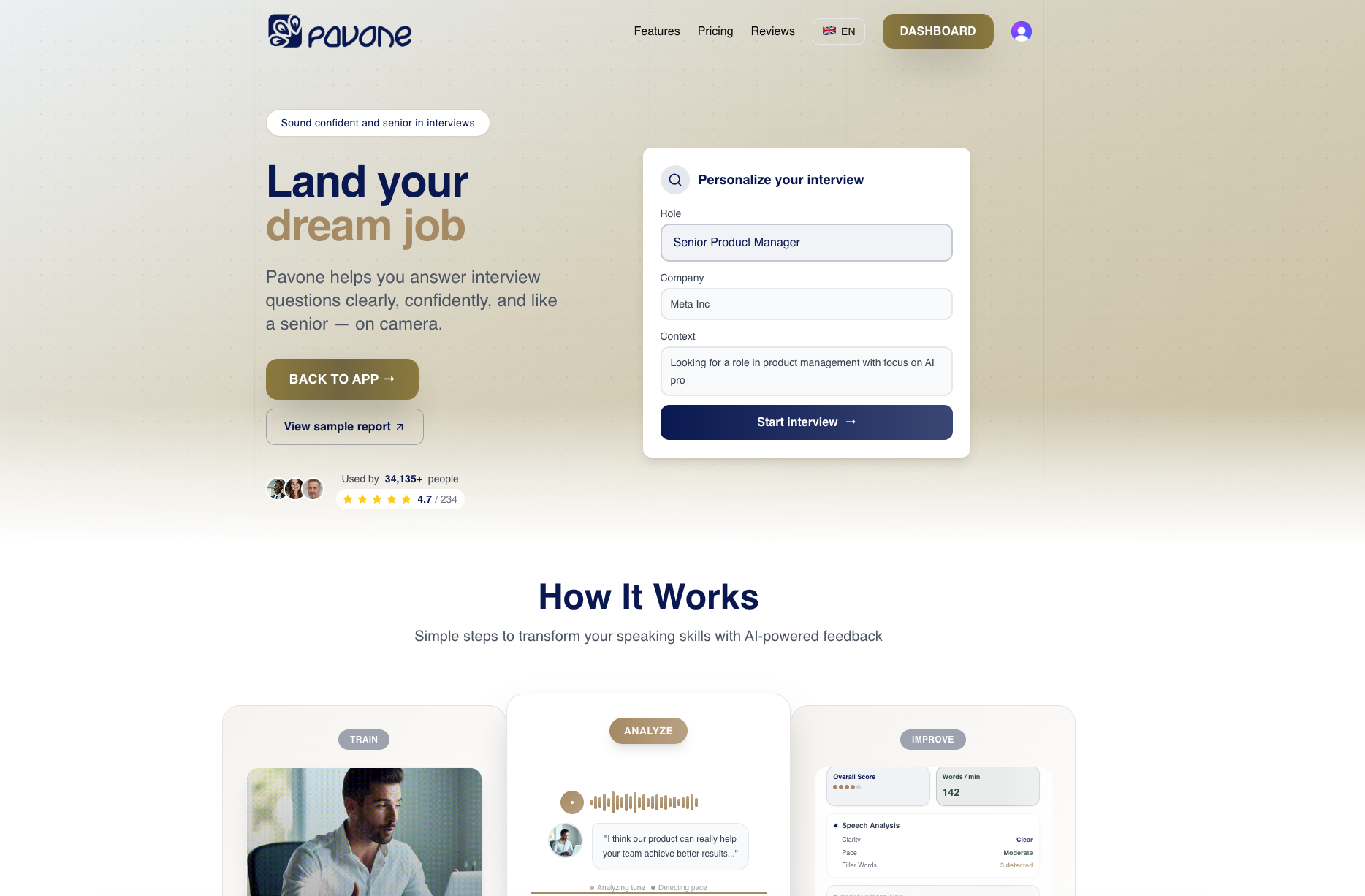
With role-specific Amazon question sets, detailed feedback after each attempt, and modules focused on confidence on camera, Pavone works like a personal interview coach available whenever you need it. Start practising today and arrive at your Amazon interview sounding exactly as senior and capable as you are.
Frequently asked questions
What is the STAR method and should I use it for Amazon interviews?
The STAR method (Situation, Task, Action, Result) is an effective way to structure behavioural answers clearly. Amazon recruiters recommend concise frameworks like STAR, though you can adapt it or use CAR for greater efficiency at senior level.
How can I improve my camera presence for a virtual Amazon interview?
Practise recording yourself answering questions on camera, focus on natural delivery rather than scripted responses, and review your recordings to catch and correct clarity issues. Presence and authenticity consistently outweigh pure memorisation in virtual interview outcomes.
Which Amazon leadership principles matter most for mid-to-senior roles?
Customer Obsession, Ownership, and Deliver Results are emphasised heavily, but all 16 principles are tested at senior level, often in combination within a single question.
Is it better to memorise answers or focus on clear, authentic responses?
Authenticity and clarity are significantly more valued than memorised scripts. Expert recruiters note that genuine presence counts more than scripted responses, so prepare key points and adapt naturally.
What’s the best way to quantify impact in an Amazon interview?
Use specific data points such as percentage improvements, revenue figures, time saved, or team size scaled. Quantifying outcomes is a core recommendation in Amazon interview preparation and signals the analytical rigour senior roles require.
Recommended
Ready to practice?
Start improving your speaking skills with AI-powered feedback and analysis.
Try Pavone Free